

Water Quality Testing on Kauaʻi
From the mountain mist to the ocean tide, water connects everything we care about—our reef, our food, our families, our future.
Our coral reefs and other nearshore marine ecosystems on Kauaʻi are culturally, environmentally and economically important to the community. Healthy reefs nurture vibrant fisheries that feed our communities and absorb wave energy which reduces the impact of storms like the recent Hurricane Lowell. Here on Kauaʻi, our coral reefs are not only existentially threatened by warming waters and global climate change, but also by local stressors like sediment, fertilizers, land-applied wastewater treatment plant effluent, septic systems and cesspool pollution, and invasive and agricultural animal wastes.
We cannot address these local stressors to coral reefs without first understanding land-based pollution sources in the watershed.
To better understand land-based pollution impacts to the Anini Lagoon, Reef Guardians Hawaiʻi partnered with WAI: Wastewater Alternatives & Innovations and Robin Knox of Water Quality Consulting, Inc. to develop a phased testing program. This partnership has since expanded to include the ___ Hui in Kapaʻa, enabling the launch of the Kilo i ke Kai water quality testing program in East Kauaʻi. Currently, testing programs are underway on the North Shore and East side of Kauaʻi.
Explore our water quality testing programs on the North shore and East Kauaʻi

North Shore
Our multi-year water quality testing program examines streams and coastal waters of Anini and Princeville. Following our one-year study, Phase II testing uses EPA methods to assess water quality conditions with the plan to submit results to the Hawaiʻi Department of Health.


East Kauaʻi
Our East Kauaʻi program, Kilo i ke Kai, builds on the water testing on the North shore. We are testing streams and coastal waters to document water quality conditions and better understand how land-based pollution moves through our watersheds from mauka to makai.
What is water quality and why is it important?
In the environment, we care about good water quality for the health of humans and the ecosystem. Clean, pollution-free streams and groundwater support healthy communities and coral reefs, which leads to vibrant fisheries and ecosystems. Some concerning pollutants for the coastal ocean include sewage, which can contain pathogens and excessive nutrients resulting in suboptimal ecosystem function; and sediment caused by erosion and development, which can impair photosynthesis in coral polyps and smother corals.
How do we assess water quality issues?
There are certain water quality parameters regulated by the Hawaiʻi Department of Health: turbidity, nutrients, and Enterococcus bacteria. Data from Reef Guardians Hawaiʻi’s water quality testing programs can be compared to thresholds defined by the Hawaiʻi DOH. We also collect data on salinity, pH, and dissoved oxygen content to better characterize the water bodies we are studying.
Turbidity
Low water clarity can indicate the presence of sediment, which can cause shading and smothering of reefs, and can transport pollutants such as herbicides.
Nutrients
Excess nutrients (i.e. Nitrogen and Phosphorus) can cause an overgrowth of algae which covers reefs and outcompetes coral, and eventually reduces habitat resiliency.
Enterococcus
Presence of this fecal indicator bacteria can indicate sewage pollution or animal feces from non-native species such as pigs, goats, or cats. High Enterococcus levels may correlate with wastewater pathogens and high nutrient levels.
How do we collect the data?
Field Sampling Methods
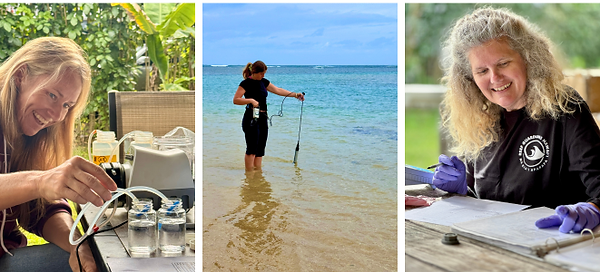
Reef Guardians Hawaiʻi uses a multi-parameter probe to measure salinity, pH, and dissolved oxygen. Water samples are taken at each site to bring sample water to the lab for further analysis.
Lab Analysis Methods
Turbidity is measured by a benchtop meter. Samples are filtered for nutrient analysis, frozen, and sent to a University of Hawaii lab. Enterococcus samples are diluted, then incubated overnight with a food source. The next day, glowing colonies are counted to determine the concentration of the bacteria.
What happens to the data?
The Hawaiʻi Integrated Report for Water Quality lists impaired water bodies throughout the state. These impaired water bodies may be prioritized for grant funding and rehabilitation projects. However, many currently listed impaired water bodies on Kauaʻi have outdated data, and some water bodies not listed have not been assessed. The Integrated Report requires submission of 30 samples collected within 2-5 years. The two testing programs in progress on the North shore and East side of Kauaʻi will establish this dataset of 30 samples for each water body. If data exceeds DOH safe thresholds and the water bodies are listed as impaired, this could open doors for watershed restoration efforts.
Water Quality Testing Program Milestones
Protecting Kauaʻi's waters begins with understanding them. Our long-term water quality testing program is building the data needed to identify water quality concerns using EPA Methods to guide future action, and ultimately to submit to Hawaiʻi DOH for consideration in the Integrated Report.
Completed
Phase I — Anini / Wanini Water Quality Testing
Established testing locations, methods, partnerships, and the initial baseline dataset.
One-Year Anini Study & Final Report
Completed the initial study, analyze the results, publish the findings, and identify priorities for continued testing.
Quality Assurance + EPA-Approved Methods
Established the QAPP and standardized sampling, laboratory, documentation, and quality-assurance procedures.
Phase II — Anini / Hanalei Water Quality Testing
Continue repeated testing at selected stream and coastal locations to build a larger qualified dataset. Added Hanalei sites to understand impact from whole Princeville plateau.
Expansion to East Kauaʻi: Kilo i ke Kai
Expand community water quality testing into East Kauaʻi and begin building additional long-term watershed datasets.
Build the Long-Term Dataset
Continue consistent testing to obtain the number and quality of samples needed for water-quality assessment.
Submit Qualified Data to Hawaiʻi DOH
Submit completed qualified datasets to the Hawaiʻi Department of Health for consideration in its Clean Water Act assessment process.
Hawaiʻi DOH Review & Consideration
Hawaiʻi DOH considers the submitted data when assessing whether water bodies meet applicable state water-quality standards.
In Progress
Future Goals

Help Protect Kauaʻi's Waters
Clean water is essential to healthy reefs.
Long-term water quality testing gives us the credible data needed to better understand conditions in Kauaʻi's watersheds and coastal waters, identify areas of concern, and work toward solutions that protect our reefs for future generations.
Your support helps fund water quality testing, laboratory analysis, equipment, supplies, and the long-term data collection needed to continue this work.